I reject condemnations of homosexuality in part because the condemners are always heterosexuals, who, like foremen of the good, command others to change without having to change themselves. The test of a moral assertion is where its burden falls. The morality of the saints makes life harder for oneself. The morality of social conservatives makes life harder for others.
My wife and I settle our arguments by deciding whom an adverse outcome would bother more. Better that one of us be slightly annoyed than the other be greatly annoyed. Rather than cajole each other or come to shouts, we weigh our would-be grievances. This leads to a policy of laissez-faire: if she wishes to attend a reunion and I do not, she goes alone, though she would rather I went with her and I would rather she stay home with me. Dragging me along would bring her less pleasure than me annoyance; vice versa if I stood in her way.
I apply this principle to the issue of gay rights. Discrimination hurts gays more than equality for gays hurts their opponents. At stake for gay people are their own lives; at stake for their opponents, merely others' lives. The effect on gays is material, direct, and daily; the effect on their opponents, abstract, remote, and occasional, concerning only the conformity of society to their moral beliefs. My neighbor, not me, gets to choose how to decorate his living room because he lives in it while I merely glimpse it through his window. Our rights extend only to the property line of our own life.
Traditional values are unjustly said to be under attack by the gay rights movement. An attack entails crossing the border into another's territory. Therefore no one can be an attacker who is merely defending his right to a share of the common happiness available to mortals. Gay rights is an issue of self-defense, which only looks like an attack because traditional values have so long forced a portion of humanity to suffer in silence.
Opposition to gay rights is commonly based on religion, which the United States Constitution forbids as the basis of law. That gays nevertheless lack equal rights under law is a reminder that, though laws govern nations, nations make and govern the laws. Therefore, if the ruling majority desires a society in which all are equal but whites can own blacks as slaves, or where church and state are separate but the state forbids gay marriage because the church says so, there is no external, independent, governing thing called Law to prevent such contradictions, nothing outside the lawmakers' own imperfect desire for moral consistency. The world is not governed by law but by power, expressed through law. Accordingly, the only way to change the world is to wield power, which in a democracy means the power to change minds.
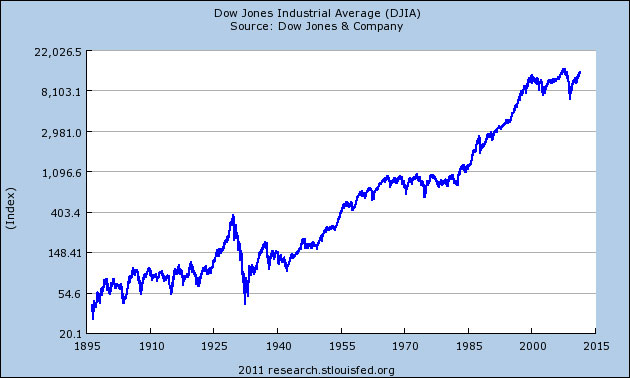
Looking at a long-term stock chart of the Dow Jones Industrial Average, I gain a sense of continuity across change. Decades of chaotic current events are condensed into an oscillating line. My finger follows the Great Crash of 1929, ascends with the post-war boom, zigzags through the recessions and oil crises of the 1970s, soars with the technology bubble then dives with the housing bust. Events that, in the moment, felt infinite because they took up all the space of the present, are in hindsight tick marks in the giant patterns of history. The traders who made the line rise and fall on the left of the chart have all lost their fortunes and entered the poorhouse of death. But greed and fear persist eternally, and now new traders move the line. Buying and selling for self, they plot a collaborative graph, as medieval masons added stones to cathedrals their ancestors started.
The narrative of history we write with our lives forgets us, recording only our aggregate effect on the world. Perishable individuals collectively shape world trends as drops of water, each bursting inaudibly on pavement, create the rhythmic sound of rain.
Reading history can feel like reading fiction in that the historian depicts a world that does not exist for us beyond the page. From the modern world of aircraft carriers, skyscrapers, oil refineries, and the United Nations, the ancient world of Roman Emperors, Visigoths, chariot races, and polytheism seems separated not merely by chronological distance but by an ontological rupture. The past feels like an alternate universe, connected to the present only by the accident of a common setting, as fiction is linked to life by taking place in factual locations, though no path leads from our world to the novelist's.
Looking at my high school yearbook gives the lie to this conception. There I am as I was, living in another and now lost world, yet the fifteen years' journey from there to here did not require crossing any chasms nor tunneling through wormholes, but only the steady arrival of tomorrows. With this realization, I gain a line of sight back to the time of togas. The distant past became the present via the smooth, paved path of days. Epochal change is the work of the small, familiar quantities of time our clocks tick off. Knowing how minutes pass, we know how millennia pass.
I instinctively envy celebrities with their adoring crowds until I remember how little I like to socialize, altering my route on walks to avoid passing long-winded neighbors. I would only have wanted to be a celebrity before cameras and television, when admirers knew your name but not your face, and you could pass among them incognito. Today's celebrities enjoy every luxury except solitude. Like fugitives, they cannot visit the grocery store without hiding in hats and sunglasses. Their fame grants them access to privileged places but bars them from common places. To know yourself seems impossible when everyone knows you. The true self is the unrehearsed self, but spontaneity hides from an audience. I pity presidents who must issue official responses immediately after tragedies, unable like laymen to have a private reaction. They cannot attend to how they feel on account of planning what they must say. Even on private retreats where the press are barred, the protagonists of future history books are seldom alone, for they violate their solitude with the thought of their posthumous biographers. In fixating on how their fans and critics see them, they evict themselves from the private residence of their soul, giving up inner knowledge for a stranger's view of the exterior.
Privacy is life's consolation prize for worldly insignificance. Whomever the public does not ignore, it enslaves. Fame is like a spice: a little flavors life, but a lot ruins it.
Before my first visit to Rome, I bought a book surveying the sculptures and paintings of the Vatican Museums. I studied the reproductions, read the commentaries and artist biographies, and learned the history of the museums—readied my mind to enter the holy of holies of Western culture. My actual visit was more productive as a study of crowds than of art. I went in the sweltering heat of mid-July, with Rome under a barbarian invasion of tourists. Unlike my leisurely review of the photographs at home, I had two hours to gulp down the originals amid a standing-room-only crush of twenty thousand visitors. Viewing art in tourist season is like visiting Mount Fuji under low clouds. Thick walls of fellow visitors' heads obscured the bottom halves of statues. Packed tour groups, like colonies of penguins, waddled, not walked, through the halls of tapestries. In the Sistine Chapel, cloaked in a miasma of human body odor, I craned my neck to see on the high ceiling the famous frescoes that at home I had held in my lap. The originals seemed faint copies of their reproductions.
Mobs of humanity consecrate a football game but desecrate an art museum. Besides getting in our way, loud families in matching T-shirts deflate our sense of sophistication as art connoisseurs. As one of the tourists, I had to acknowledge myself a contributor to the annoyed expressions of tour guides and security guards. I noted with displeasure that two of the armpits I smelled were my own. On my pilgrimage to culture, I felt like a philistine.
Some nights my wife is late getting home, and, bypassing the innocent explanation that she is running errands or had a meeting after work, my mind flies to the thought it dreads: she has wrecked her car, she is never coming home. I permit these morbid hypotheses because they renew my love with miraculous potency. In the midst of my anticipatory mourning, I hear a key turning in the lock: the door opens: she is resurrected from the dead! I kiss her and thank fate, and she kisses back, perplexed by my excess affection. For a happy marriage, the only counseling couples need is an occasional fear that each other has died.
Gossip consists of two people bonding with each other at someone else's expense. Over drinks after work, new friends speak ill of a co-worker. They do not mean to be mean. Rather, their unkind words are an offering of kindness to each other, as if to say, See how much more I like you than I do him.
We appreciate similarity by contrast with difference. Amid the foreign speech and customs of other cultures, we make instant friends with a fellow countryman, chattering like long-lost companions, though on streets at home we would pass each other by as strangers. We exchange phone numbers but never call, because once home among friends, a shared homeland is an unremarkable bond.
A common enemy makes former enemies friends. Political parties battle each other in times of peace, while national unity is rarely so strong as in time of war. Widening the logic, if a hostile race of extraterrestrials arrived to annihilate earth, Iran and Israel would hold hands for the good of humanity.
Parents who boast of their child's developmental progress mistake a general miracle for a particular miracle. They do not so much overestimate the progress but the uniqueness of their child. Watching a being who was recently nonexistent learn to walk, speak, and socialize, they rightly marvel, but because their sample size is one, they assume they birthed a prodigy. Their judgment suffers from a deficiency not of accuracy but of scope. Could they watch other children grow up, they would discover them to be prodigies too. Their praise would spread from their family to humanity, their pride change to wonder.
Success, by way of ambition, leads to failure. The more we achieve, the more we think we can achieve; our hopes rise exponentially in relation to our skill. Talented drama students, heartened by the cheers of local audiences, journey to Hollywood after high school, where everyone was a talented drama student, and there are only jobs as extras. The best baseball players in the minor league go to the major league, where they are the worst players. As air bubbles rise through water and dissolve in the atmosphere, the above average rise until they are average. As we ascend the ranks, our status falls.
I travel to taste life in another place, but what I primarily taste, wherever I go, is the life of travel. In the taxonomy of experience, traveling occupies a single genus regardless of destination: a life of looking at things. I walk down streets, tour buildings, photograph statues, stand at scenic overlooks. The sights change, but the flavor of sightseeing stays the same. We over-associate travel with adventure and growth. Traveling can be as repetitive as any activity. Reliving the same vacation in destinations around the world, one discovers the cosmopolitan life to be oddly provincial. Traveling is an experience rather than an avenue to experience.
Mr. Stanley’s Aphorisms and Paradoxes are outstanding examples of the long-form aphorism...
inevitably studded with discrete individual aphorisms that could easily stand on their own.
-James Geary, author of The World in a Phrase: A Brief History of the Aphorism