Aphorisms
Essays About Resume
Showing: long form short form

Some nights my wife is late getting home, and, bypassing the innocent explanation that she is running errands or had a meeting after work, my mind flies to the thought it dreads: she has wrecked her car, she is never coming home. I permit these morbid hypotheses because they renew my love with miraculous potency. In the midst of my anticipatory mourning, I hear a key turning in the lock: the door opens: she is resurrected from the dead! I kiss her and thank fate, and she kisses back, perplexed by my excess affection. For a happy marriage, the only counseling couples need is an occasional fear that each other has died.

Gossip consists of two people bonding with each other at someone else's expense. Over drinks after work, new friends speak ill of a co-worker. They do not mean to be mean. Rather, their unkind words are an offering of kindness to each other, as if to say, See how much more I like you than I do him.

We appreciate similarity by contrast with difference. Amid the foreign speech and customs of other cultures, we make instant friends with a fellow countryman, chattering like long-lost companions, though on streets at home we would pass each other by as strangers. We exchange phone numbers but never call, because once home among friends, a shared homeland is an unremarkable bond.

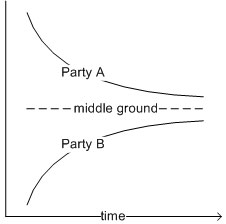
A common enemy makes former enemies friends. Political parties battle each other in times of peace, while national unity is rarely so strong as in time of war. Widening the logic, if a hostile race of extraterrestrials arrived to annihilate earth, Iran and Israel would hold hands for the good of humanity.

Parents who boast of their child's developmental progress mistake a general miracle for a particular miracle. They do not so much overestimate the progress but the uniqueness of their child. Watching a being who was recently nonexistent learn to walk, speak, and socialize, they rightly marvel, but because their sample size is one, they assume they birthed a prodigy. Their judgment suffers from a deficiency not of accuracy but of scope. Could they watch other children grow up, they would discover them to be prodigies too. Their praise would spread from their family to humanity, their pride change to wonder.

Success, by way of ambition, leads to failure. The more we achieve, the more we think we can achieve; our hopes rise exponentially in relation to our skill. Talented drama students, heartened by the cheers of local audiences, journey to Hollywood after high school, where everyone was a talented drama student, and there are only jobs as extras. The best baseball players in the minor league go to the major league, where they are the worst players. As air bubbles rise through water and dissolve in the atmosphere, the above average rise until they are average. Ascending the ranks, our status falls.

I travel to taste life in another place, but what I primarily taste, wherever I go, is the life of travel. In the taxonomy of experience, traveling occupies a single genus regardless of destination: a life of looking at things. I walk down streets, tour buildings, photograph statues, stand at scenic overlooks. The sights change, but the flavor of sightseeing stays the same. We over-associate travel with adventure and growth. Traveling can be as repetitive as any activity. Reliving the same vacation in destinations around the world, one discovers the cosmopolitan life to be oddly provincial. Traveling is an experience rather than an avenue to experience.

We want to get to the place where history happened. We feel nearer antiquity when we stand in the Roman Forum, though we have only moved nearer in space, not in time. We are moved by an empty field of grass because a Civil War battle was fought there once. We travel great distances to museums to see original paintings that we have seen as clearly and without the crowds in reproductions, because our eyes must rest on the canvas the master's hand touched.

But does the body of history lie in the shrines where we seek it? Space is as restless as time. After one hundred fifty summers of new growth, the grass in the Civil War field is not the grass the soldiers stood on. The museum's famous paintings glow with oil pigments from the restorer's, not the artist's, brush. In the Roman Forum, we walk upon the dust from prior visitors' shoes and breathe the air that they, not the ancients, exhaled. Caesar's dust has likely disappeared from Rome, but we may find it in our garden when we get home, if the winds of two millennia have blown it there.

I never work so hard as on vacation. For weeks before my departure, I cannot relax on weekends because I must research and plan. Hail to the free spirits and gypsies who can find their way as they go. I have learned that any decision I neglect to make in advance, I will have to make in the moment, when time is scarcer, stress higher, and strangers waiting for my answer. My task—from a starting point of zero knowledge, to determine what to do, how long, and in what order—appears conquerable from a distance, but the more I learn, the more complexities emerge. The restaurant and theater I have chosen for Wednesday night are not in walking distance. The museum for Saturday is closed weekends. Research, before it yields solutions, multiplies problems.

On arriving, I tighten into a state of poise and tension: I must be more alert to compensate for being less familiar. Hailing a taxi, ordering food, and talking with a hotel receptionist follow rules and conventions I am ignorant of. I am reborn into childhood, my decades of education and social instruction made irrelevant. I revert to feelings of self-consciousness not felt since adolescence.

Finally, my vacation is over, and I can go back to work and rest.

The worst part of travel is the traveling. The destination is my goal, the journey the unfortunate cost. I lose two days of a precious week's vacation to airplanes, car rental counters, and waiting in traffic on freeways. The chore of changing locations compels me, against my wish, to do my traveling all at once: to cram four cities into five days, to rise earlier on vacation than I do at home, to choose exhaustion over the regret of slowing down. I wish I could travel like I eat, in small regular meals, not once-a-year binges. I daydream of a network of machines that would atomize my body at my origin and reassemble it from other atoms at my destination, so I could visit Russia over my lunch hour or take my evening walk in Rio. Absent an atomizer, give me the bullet train of books, which whisk me across continents in an instant without suitcases or jet lag. I want to see too many places to wait for matter to tag along. A traveler packs too heavy if he takes his body with him.

Visiting foreign countries, I can never suppress a sense of the inefficiency of humanity speaking multiple languages. Each language repeats with slight variation what every other language already says, like people in group discussions who, to assert themselves, restate in their own words and examples every comment anyone makes. The redundancy of languages suggests the lack of a world supervisor. Earth's societies are like children playing without an adult, each making its own rules which no one else abides by.

Abroad, I experience life like a deaf person, interpreting faces instead of phrases. Watching Greek women make small talk by a storefront or Italian cab drivers hurl angry sounds at other drivers, like cab drivers at home, I feel falsely divided from my fellow man. Beneath their opaque words are recognizable actions and emotions. Nature gave them and me the same brain, but culture divided us with different sounds for getting our thoughts out.

I grant that linguistic diversity adds color to the world, and that I will never know Dante truly if I read him in translation, but the bar of cosmopolitanism is too high. I tend to give up learning languages after a few months, for it is odious to regress from a mastery of English to a second-grade knowledge of French or German—from deciphering Melville to deciphering menus.

I sympathize with religions that see language as God's gift and diversity of language as God's curse. Humanity has over-solved the problem of communication. Once, we were isolated from each other by lack of speech. Now, by excess.

Could I be any kind of celebrity, I would not be a politician. No celebrity can be admired by everyone, but most celebrities are merely ignored by non-admirers. A famous scientist bores and confuses the masses, who therefore pay no thought to famous scientists. Teenagers who do not like a pop star simply do not buy her albums. But whoever does not like a politician is likely to hate him, because what he produces are not albums but laws. Few can be indifferent toward someone whose actions reach into their lives. Political fame must send confusing signals to self-esteem. Does a president toast his ego that he was elected, or despair that polls show half the nation hates him?

Europe's cathedrals sublimely evoke the absence of God. They are temples that have decayed into museums. Tourists, not worshippers, fill their naves, driven by curiosity, not faith. One does not pay alms anymore but admission fees. The altar is roped off, not because it is sacred, but fragile. The silence of emptiness has replaced the silence of holiness.

Wandering past vacant pews and pulpits among guidebook-toting spectators, I become briefly nostalgic for the cathedrals' sacred past, until, opening my guidebook, I study that past and find nothing sacred. The glittering walls and shrines are decorated with ill-gotten gold, stolen relics, and war booty. The soaring domes and spires were raised to heaven not from piety but ambition, to outdo nearby cathedrals and show that Florence was better than Pisa, as modern Malaysian and Shanghai architects compete to build the tallest skyscraper. The niches are filled with the tombs of the rich, not because rich men were holy then but because they wanted to buy the best salvation for themselves, as today's rich use their millions to nuzzle up to power and buy the best laws and policies for themselves. In the cathedrals' history as opposed to their aura, I recognize the same political machinations, class inequality, greed, and immorality that rule the world today—the trademark signs of man curiously grafted onto religion. Life has left Europe's cathedrals, but God was never there.

A secular and a religious society are equally profane, for a secular society banishes the sacred, while a religious society defiles it with the human.

Comedy is the most unforgiving genre. For a novelist, poet, or scholar, an admixture of mediocrity need not be damning. An occasional prosaic thought can pass unnoticed amid the greater thoughts around it, just as no one notices the mulch in a bed dense with flowers. Even Milton writes dull verses sometimes, which we enjoy reading because they let us rest from interpretation.

But for a comedian alone among writers, anything that does not hit, misses. A joke that falls flat cannot fall back to being filler; no lower purpose redeems it. A poor punch line in a stand-up act, instead of fading in the surrounding laughter, creates the awkward silence that everyone in the audience remembers. Every comedic utterance that is not a triumph is a failure.

A comedian needs courage besides humor.

open quote Mr. Stanley’s Aphorisms and Paradoxes are outstanding examples of the long-form aphorism... inevitably studded with discrete individual aphorisms that could easily stand on their own. close quote

-James Geary, author of The World in a Phrase: A Brief History of the Aphorism

Titles - All