At a wedding last weekend, a girl was present whom my wife had not seen since high school and did not recognize at first. Apparently in high school she was rather plain and unremarkable, whereas now, at 26 or 27, she is all elegance and glamour. She is living in Boston as a shoe designer. She wore a black, backless dress with a low, V-shaped front. Her hair was no longer straight and brown but blond and wavy, and she wore it half-up. She had a tan without being too tan. She smiled and talked to her friends and drank a beer and danced often.
The next day, reviewing her old appearance in my wife's high school yearbook, I was surprised by her transformation, for in the old photo it was clearly the same face, and all that seemed to have changed was her hairstyle, her fashion, and her posture (which in the photo was slumped and unconfident). I had trouble deciding whether her high school plainness had masked a beautiful face, or her twenty-something glamour now masks a plain face. I tend to think the former, and if so, it makes me wonder how many other girls may be beautiful incognito.
Had my wife not told me this girl was not always so attractive, I might have guessed it from her demeanor. She acted like someone newly pretty. Girls who have always been pretty strut about like shining goddesses among mortals, aloof and scornful. Woe to the flirtatious male if he is not as gorgeous as she! Woe to any friend who aspires to be more than her mere attendant! The girl at the wedding was too unused to her looks to be arrogant. She evidently retains the fresh memory of her adolescent plainness and is still learning to believe in her new beauty, as if the mirror's reflection and men's attention compete in her self-esteem against the insecurities engrained over years. She hopes, rather than quite believes, in her beauty; her fledging faith craves additional proof. When men smile at her, her sincere and surprised smile seems to say, "then you do find me pretty?"
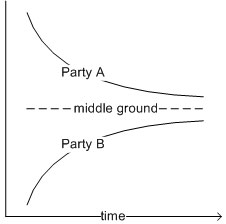 Negotiators—whether politicians or homebuyers—begin with bold concessions which rapidly shrink the gulf between opposing sides. But like curves approaching an asymptote in geometry, as they near an agreement they level off and struggle to bridge the final, though trivial, gap. The effect of their ongoing quarreling is that, by the end, their motivating goal is not so much to strike a deal or make a sale as to make the other side yield, on no matter how minor a point. The fact of winning a concession matters more than the concession's substance. Not who yields most, but who yields last, appears to lose. The negotiation grows more bitter, the less remains at stake.
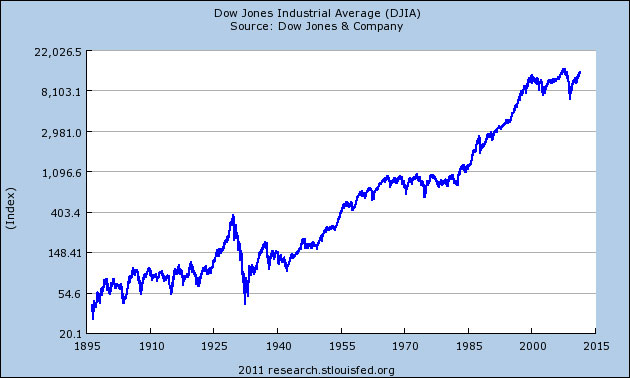 Looking at a long-term stock chart of the Dow Jones Industrial Average, I gain a sense of continuity across change. Decades of chaotic current events are condensed into an oscillating line. My finger follows the Great Crash of 1929, ascends with the post-war boom, zigzags through the recessions and oil crises of the 1970s, soars with the technology bubble then dives with the housing bust. Events that, in the moment, felt infinite because they took up all the space of the present, are in hindsight tick marks in the giant patterns of history. The traders who made the line rise and fall on the left of the chart have all lost their fortunes and entered the poorhouse of death. But greed and fear persist eternally, and now new traders move the line. Buying and selling for self, they plot a collaborative graph, as medieval masons added stones to cathedrals their ancestors started.
 Mr. Stanley’s Aphorisms and Paradoxes are outstanding examples of the long-form aphorism... inevitably studded with discrete individual aphorisms that could easily stand on their own.