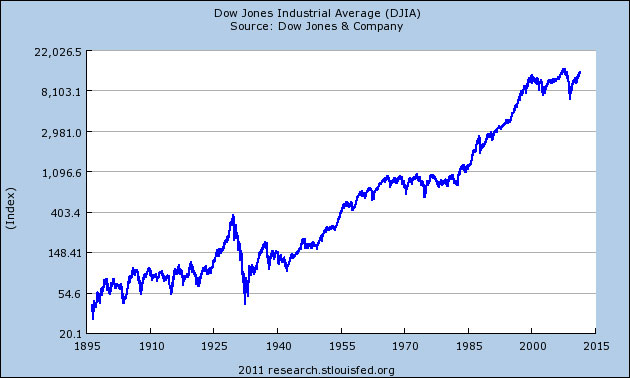
 Looking at a long-term stock chart of the Dow Jones Industrial Average, I gain a sense of continuity across change. Decades of chaotic current events are condensed into an oscillating line. My finger follows the Great Crash of 1929, ascends with the post-war boom, zigzags through the recessions and oil crises of the 1970s, soars with the technology bubble then dives with the housing bust. Events that, in the moment, felt infinite because they took up all the space of the present, are in hindsight tick marks in the giant patterns of history. The traders who made the line rise and fall on the left of the chart have all lost their fortunes and entered the poorhouse of death. But greed and fear persist eternally, and now new traders move the line. Buying and selling for self, they plot a collaborative graph, as medieval masons added stones to cathedrals their ancestors started.
The narrative of history we write with our lives forgets us, recording only our aggregate effect on the world. Perishable individuals collectively shape world trends as drops of water, each bursting inaudibly on pavement, create the rhythmic sound of rain.
 Mr. Stanley’s Aphorisms and Paradoxes are outstanding examples of the long-form aphorism... inevitably studded with discrete individual aphorisms that could easily stand on their own.