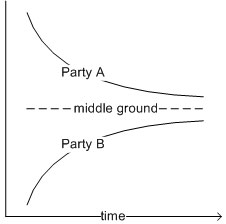
 Negotiators—whether politicians or homebuyers—begin with bold concessions which rapidly shrink the gulf between opposing sides. But like curves approaching an asymptote in geometry, as they near an agreement they level off and struggle to bridge the final, though trivial, gap. The effect of their ongoing quarreling is that, by the end, their motivating goal is not so much to strike a deal or make a sale as to make the other side yield, on no matter how minor a point. The fact of winning a concession matters more than the concession's substance. Not who yields most, but who yields last, appears to lose. The negotiation grows more bitter, the less remains at stake.
Politics
The one who first states a case seems right, until the other comes and cross-examines. -Proverbs 18:17
In politics, everyone has a reasonable point. And because everyone is right, everyone is wrong-headed.
We assert the need for spending cuts while condemning cuts to programs that affect us. Our convictions rest on sound arguments applied inconsistently. We do not so much only care about our favorite programs as only know about our favorite programs. Thus we apply a specific logic in defense of them—the good they do—while applying a general logic against unknown programs—the overall need to trim deficits.
In abortion debates, opposing sides do not so much disagree on an answer as compellingly answer different questions. Pro-life advocates depict a battle between a woman and a fetus, in which no human has a right to decide if another should live. Pro-choice advocates depict a battle between a woman and the government, in which no senator has a right over a woman's reproduction.
The rich protest the estate tax unfair because it taxes the same wealth twice. The poor protest it unfair that they have no estate to tax.
Nothing hinders a fair hearing for truth like cogent arguments. No sooner are we convinced of the merit of our logic than we close our minds to the merit of other logics. In college, I wondered how great thinkers, reading the same map of world facts, could reach such contradictory conclusions.
Skeptics are right to doubt the dogmas of the convinced, but for the wrong reason. Truth eludes us not because there are no certainties in life, but because there are too many.
Could I be any kind of celebrity, I would not be a politician. No celebrity can be admired by everyone, but most celebrities are merely ignored by non-admirers. A famous scientist bores and confuses the masses, who therefore pay no thought to famous scientists. Teenagers who do not like a pop star simply do not buy her albums. But whoever does not like a politician is likely to hate him, because what he produces are not albums but laws. Few can be indifferent toward someone whose actions reach into their lives. Political fame must send confusing signals to self-esteem. Does a president toast his ego that he was elected, or despair that polls show half the nation hates him?
Politics is the complex process by which leaders don't make decisions.
Given the chicanery of politicians and the complexity of politics, how can one be an informed voter? Clear information about the candidates is inaccurate, while accurate information is unclear. The candidates lecture more of each other than themselves, which is like learning from cats about dogs. Experts disagree as fiercely as rally-goers. Examining the issues for oneself deepens rather than dispels confusion. Will tax breaks boost or bankrupt the economy? Will a calm or threatening voice quell rowdy nations? Minus doctorates in economics, health policy, international relations, sociology, education, and military history, most voting is mere guessing. We pick leaders without knowing what the leaders say they will do, or if they will do what they say, or if what they do (whatever they do) will work.
If voters reined their opinions within their knowledge, ballot boxes would be empty and bumper sticker makers would go bankrupt. Fortunately for the continued functioning of government, few people need facts to feel conviction.
The right to vote gives democratic societies a sense of autonomy over the future. But democracies differ from the monarchies they replaced only as drawing a card in black jack differs from being dealt one. We choose our fate but do not know which fate we are choosing.
Our actions can change the world, but unfortunately we cannot anticipate how. Every intended change leads to a cascade of unintended changes. The world is a vast uncomprehended hydraulic system: push something in and something unexpectedly pops out on the other side.
Industrializing to lift ourselves from the poverty of agrarian life, we unintentionally opened the spigots of pollution now drowning us. Punishing the Germans for starting World War I, the Allies made them desperate enough to start World War II. Helping Afghanistan defeat the Soviets in the 1980s, the United States armed turbaned zealots with the weapons they now attack us with.
Neither the ancient pessimists who saw humans as pawns of destiny, nor modern picketers who think all problems are problems of willpower, are correct. We possess the power of gods but we administer it with the ignorance of mortals. Electing politicians is like electing which passenger should take the controls of a plummeting airplane. Everything depends on who is chosen and which buttons he pushes, but which buttons he pushes depends more on luck than skill.
The self-importance of politicians is therefore comical. For an accurate idea of political power, picture a peace summit where a world leader, grandly gesturing about his peace plan, knocks down his foreign counterpart and kills him, thereby starting a war.
During campaign seasons, I tire of the candidates' attack ads and mutual rummaging through one another's past sins. Such faultfinding, most of it false or exaggerated, seems not only mean-spirited but also petty and immature, like children too eager to tattle. One expects rudeness from taxi drivers or football fans, but not from men and women seeking the highest offices of government. Are these self-promoting finger-pointers to be the leaders of nations? But then I remember the old days, when would-be kings, backed by armies instead of campaign teams, rode out to bloody battles, took their rival's children captive, and cut off each other's head to gain the crown. From murder and kidnap, to mere lies and slander. Civilization is making progress.
My wife and I settle our arguments by deciding whom an adverse outcome would bother more. Better that one of us be slightly annoyed than the other be greatly annoyed. Rather than cajole each other or come to shouts, we weigh our would-be grievances. This leads to a policy of laissez-faire: if she wishes to attend a reunion and I do not, she goes alone, though she would rather I went with her and I would rather she stay home with me. Dragging me along would bring her less pleasure than me annoyance; vice versa if I stood in her way.
I apply this principle to the issue of gay rights. Discrimination hurts gays more than equality for gays hurts their opponents. At stake for gay people are their own lives; at stake for their opponents, merely others' lives. The effect on gays is material, direct, and daily; the effect on their opponents, abstract, remote, and occasional, concerning only the conformity of society to their moral beliefs. My neighbor, not me, gets to choose how to decorate his living room because he lives in it while I merely glimpse it through his window. Our rights extend only to the property line of our own life.
Traditional values are unjustly said to be under attack by the gay rights movement. An attack entails crossing the border into another's territory. Therefore no one can be an attacker who is merely defending his right to a share of the common happiness available to mortals. Gay rights is an issue of self-defense, which only looks like an attack because traditional values have so long forced a portion of humanity to suffer in silence.
Opposition to gay rights is commonly based on religion, which the United States Constitution forbids as the basis of law. That gays nevertheless lack equal rights under law is a reminder that, though laws govern nations, nations make and govern the laws. Therefore, if the ruling majority desires a society in which all are equal but whites can own blacks as slaves, or where church and state are separate but the state forbids gay marriage because the church says so, there is no external, independent, governing thing called Law to prevent such contradictions, nothing outside the lawmakers' own imperfect desire for moral consistency. The world is not governed by law but by power, expressed through law. Accordingly, the only way to change the world is to wield power, which in a democracy means the power to change minds.
Gossip consists of two people bonding with each other at someone else's expense. Over drinks after work, new friends speak ill of a co-worker. They do not mean to be mean. Rather, their unkind words are an offering of kindness to each other, as if to say, See how much more I like you than I do him.
We appreciate similarity by contrast with difference. Amid the foreign speech and customs of other cultures, we make instant friends with a fellow countryman, chattering like old companions, though on streets at home we would pass each other by as strangers. We exchange phone numbers but never call, because once home among friends, a shared homeland is an unremarkable bond.
A common enemy makes former enemies friends. Political parties battle each other in times of peace, while national unity is rarely so strong as in time of war. Widening the logic, if a hostile race of extraterrestrials arrived to annihilate earth, Iran and Israel would hold hands for the good of humanity.
We live in slavery to our ambitions. We complain of doing what no one makes us do. In the workplace, companies strain to meet the stratospheric goals naively conceived in the zeal of a board meeting. Executives restructure divisions, employees work weekends, managers cut costs and strain nerves to meet deadlines, overlooking the simpler solution of swapping their original fantasy for realism. For the pride of being president, the successful politician endures public ridicule, early gray hair, and a daily bread of crisis. At home, we plan parties meant to be fun then wither and growl under the stress of baking dessert and cleaning the house. Many nights I hate to sit down and write, but long ago some former self decided to do it, and, like a child raised under strict religion, backsliding afflicts me with guilt.
We groan under the law and forget that our own hands carved the tablets. Why not smash them instead of obey them?
Since people speak of the rights of the unborn, why not the rights of the unconceived? They are a vast and voiceless class in our ovaries and testicles. Their numbers are numberless: every possible combination of every egg and sperm in the world. One needs advanced mathematics to tally the lives that could be. We abort these lives every moment of not having sex. When a couple comes home from work too tired for lovemaking, they are choosing television over a child's existence. When teenagers hold in their hormones to please their preacher, they deprive an unborn soul the chance of heaven. In refusing to fuse their gametes on sidewalks and subways, strangers stunt the progress of humanity, out of mere propriety.
The pro-life movement should insist on our moral duty for unprotected sex, adultery, and promiscuity.
A book I am reading notes that the idea of being "modern" originated in the Middle Ages. It is odd to think of flagellating monks and Canterbury pilgrims regarding themselves as modern. Even odder to think how, like them, we moderns will one day seem medieval. In a few hundred years, today's books will appear silly with their solemn talk of the modern world. A book about recent trends in capitalism will sound as contemporary as a book about recent trends in feudalism. "The War on Terrorism" will have the ring of "the War of the Roses." Solar energy will be as cutting edge as firewood.
 Mr. Stanley’s Aphorisms and Paradoxes are outstanding examples of the long-form aphorism... inevitably studded with discrete individual aphorisms that could easily stand on their own.
-James Geary, author of The World in a Phrase: A Brief History of the Aphorism
As Seen In:




Follow


